Friday, August 13, 2010

Cover Stars

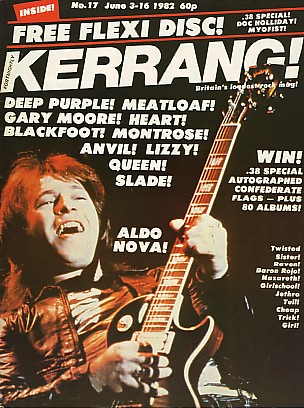
There is a great Flickr set of old (and I mean old) Kerrang! covers which you can find over here. What I find interesting when I'm browsing through them are not the ones featuring Heavy Metal Royalty like AC/DC or Iron Maiden, but the ones that have you squinting your eyes, leaning forward and going "who's that? Aldo .... Nova ....who?"


I sort of remember Aldo Nova. I remember Kerrang! in 1982 pushing him as the next big thing from the US. Until they realised that Motley Crue were the sort of big things the States were going to produce, upon which Aldo Nova already seemed dated. Which is kind of impressive when you think about it.

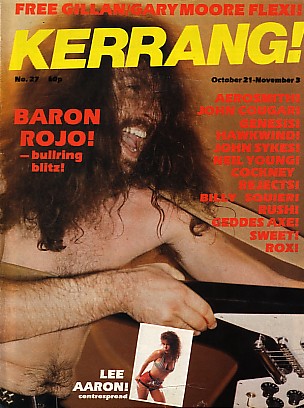
Other curious cover stars included Baron Rojo, who made it onto the cover of No. 27 in October 21 - November 3, 1982. A fact that makes you suspect that the release schedule was a bit light on big names in October 21 - November 3, 1982. British headbangers in 1982 just weren't ready for a Spanish Heavy Metal band (though they were probably more receptive to the centrefold of Lee Aaron showing off her knockers while dressed in hooker chic). You'll notice that both of these issues had free flex discs; they weren't stupid.

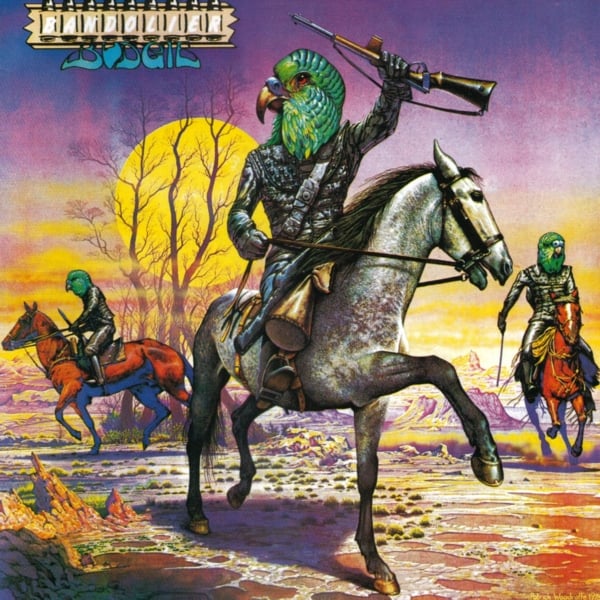
Or maybe they were, because just two issues later they put Budgie on their cover. Budgie! In 1982!


I always thought Budgie were silly. Think I'm being unfair? OK, have a look at this and then this and come back. There, I'm glad we've got that settled. Budgie were on their last legs in 1982, but, to be fair that's not unusual when you look at the acts that made the cover in Kerrang!'s first year. In 1982, bands like Black Sabbath, Thin Lizzy and Rainbow were breathing their last. While even newer bands like Saxon, Motorhead, Iron Maiden and AC/DC had made their best albums (though some of those went on to be successful all the same). Kerrang!'s first year was remarkably backwards-looking. It's interesting that the magazine has survived so long.

Wednesday, August 4, 2010

Strangers & Long-Awaited Friends


Me and Rush go back a long way. Perhaps like a lot of folk I got into them via the presence of albums like Fly By Night and 2112 in an elder brother's record collection. It also probably helped that just when I was starting to buy records they were at their commercial (and arguably artistic) peak, making albums like Permanent Waves and Moving Pictures. Anyway, I bought a lot of their albums up until the ones in the mid 80s when keyboards started to dominate and I lost interest.

I'm mentioning this because I've just watched Beyond the Lighted Stage, the new documentary about them and it's very good. In many ways it sets a template for a band documentary, with a strong, revelatory opening about their youth and early years followed by a trail through their story that doesn't focus too much on any one period while neglecting others. And it's helped by the subject matter themselves who prove to be surprisingly good company. I never expected them to be prima donnas, but I didn't expect them to be so good-natured and funny. there's a scene at the end of the film where they've having dinner (and getting merrily drunk) at a hunting lodge. Even Neil Peart, who comes across as reserved and a bit prickly, relaxes in the atmosphere, and there's real affection on show. It's all genuinely touching.   

The film ends with their career on an upswing, and if the film can be said to have an agenda, it seems to be that it wants to be the first broadside in a battle to change Rush's image and make them cool (I was going to write "rehabilitate" there, but I realised that they never were really "habilitated" - they've always been deadly uncool). This probably explains the choice of the talking heads (Trent Raznor, Jack Black, Billy Corgan), which seems to make the point that not only science students like Rush, people with good haircuts and tattoos also like them. They're shown making an appearance on The Colbert Report, where the host expresses outrage that they're not in the Rock & Roll Hall of Fame.

And yet ... is this what Rush fans want? Rush can't really be short of money. They have a large back catalogue that has presumably ticked over pretty nicely for over 30 years, and they can fill arenas (and stadia in Brazil) whenever they want to tour. Do we really want to see them being inducted into the Rock & Roll Hall of Fame, with Bono giving a video message where he calls Tom Sawyer a "Hymn"? Do we want talent show contestants and models wearing 2112 Tour Shirts? In the film, Geddy Lee calls Rush the "world's biggest cult band". He's probably right. And probably happy about it that way too.

Sunday, July 18, 2010

Freddie Mercury Makes a Bad Decision


I'm fascinated by the moments when acts momentarily lose the plot. Those occasions when desperation, a cocaine habit or just sheer wrong-headedness convince them that it would be a good idea to go off in a new bold, direction. Maybe release an album that could be the soundtrack to a film about a race of people called The Elder that the bass player has just thought up? Or how about a double album of instrumentals about plants? Clear a space on the wall for the platinum disc, Jeeves!

Queen had their wobbly moment in 1982. In a sense it was unexpected; they were following-up an album, The Game, that had got to number one in the UK and US, and had yielded two no. 1 singles in the latter country. One of those was Another One Bites the Dust, and it's tempting to imagine that Freddie Mercury concluded from this that, you know,maybe their fans would love to hear more funk and disco songs.

The result was Hot Space, a dog of an album where half the songs were unsuccessful attempts at sounding like Chic, while the other half were unsuccessful attempts at sounding like Queen. Some of the much-maligned funk stuff isn't that bad: both Staying Power and Body Language have plenty of hooks. It's the rock songs that are the real clunkers: Brian May's Las Palabras De Amor is the wettest thing he ever wrote, while it probably takes longer to listen to Calling All Girls than it took Roger Taylor to write it. The final track is Under Pressure, which was recorded and released a year before the rest of the album and sits there on the track listing like a university student at a family party, aloof and slightly embarrassed.

Yet, Hot Space was an important album for the group because it had a legacy. Queen weren't stupid, and learned their lesson. They came back in 1984 with The Works, which gave them a clutch of hits and some fresh momentum. But it was an unadventurous, by-the-numbers album, and as the 80s progressed, their records got duller and duller. A band once known for being innovative and taking risks settled into churning out tame corporate rock that had you yearning for a few Bismillahs or Galileos. Or maybe even some funky bass lines and horn arrangements. No, on second thoughts, maybe not.

Sunday, March 21, 2010

The Italian Wave of British Heavy Metal

 Over here in Italy there's a very good magazine called Classix Metal, that devotes itself to writing about 80s Heavy Metal of all shades. It's essentially a well-produced fanzine (which is surely the only way to describe a publication that has a nine page Raven retrospective or an article on Mausoleum Records). Still, it's all the better for it, meaning that it's enthusiastic about its subject matter and doesn't take itself too seriously.

In a recent issue there was an article that traced the history of Heavy Metal in Italy. This was interesting to me, as I don't normally associate sunny, Mediterranean countries with Heavy Metal (I'm trying to think of what could be the Italian version of Birmingham - Turin? Not quite the same).

One thing that struck me was that a lot of the Italian bands had names that would make the UKIP proud: Gunfire, Spitfire, Royal Air Force, Steel Crown and my personal favourite - Drunkards. It's an often overlooked fact how NWOBHM bands promoted British culture abroad - well, if you can call wearing a sleeveless Union Jack shirt promoting culture. Nonetheless, the net effect was that in the 80s, there were a raft of European Metal Bands being formed who had names straight out of the Warlord or Victor comics.

Having said all that, the band that really made an impression were the tastefully-named Death SS. The band were active from the late 70s until the late 80s and seem to have been a cross between Alice Cooper, Kiss and Scooby Doo Where Are You? You can see a picture of them from 1980 below (I scanned it directly from the magazine as I didn't fancy putting "Death SS picture" into Google).


And in case you're wondering - and I know you are - the Mummy played bass.

Still, everybody needs to move with the times (even a band with songs called Zombie Terror and Black Mummy), and as the 80s progressed Death SS, like so many other bands, weren't immune to the increasing popularity of Hair Metal. Look at the photo below from 1988.


Def Leppard meets the Wolf Man! Even the Mummy had a soft perm. The faun seems to have turned into a badger, too.

Friday, March 12, 2010

10 Random Thoughts on "Heavy Metal Britannia"


1. All that "proto-metal" stuff with Blue Cheer, Cream and the Edgar Broughton Band etc didn't really convince and took up too much time. Metal is about more than just hitting the instruments hard, and as good as those bands were, I'm listening to the first Black Sabbath album as I write this, and none of these bands really anticipate or predict it. It all starts here.

2. Rob Halford seems a decent bloke.

3. Hasn't Brian Tatler off of Diamond Head aged badly? And since when were Diamond Head as important as Saxon and Iron Maiden?

4. Deep Purple's music hasn't aged too well. And they weren't really metal. Well, maybe "Speed King"

5. Burke Shelley is a bit of an arse

6. Bill Ward has a hell of a boozer's nose. But he seems a lovely man.

7. Judas Priest's influence is overlooked. If you look at the NWOBHM bands, their sound can be traced back to Black Sabbath - but they sound more like Judas Priest.

8. Most Heavy Metal musicians aren't very articulate when it comes to defining Heavy Metal: "It's kind of .. you know, heavy"

9. Mick Box's interesting "ear flaps" theory that bands were protected from the noise from the amplifiers because ears "face forward" is an interesting one, but may not stand up to rigorous scientific examination.

10. "Symptom of the Universe" was a perfect choice for the song over the credits. Be honest.