Monday, October 6, 2025

Bon in Fremantle


He's pretty easy to find. Leave the station at Fremantle and head right towards the fishing harbour (there's a bus, but I've never taken it). Takes about 10-15 minutes. There are a bunch of seafood restaurants along the strip at the harbour and I recommend the fish and chips at Cicerello's, though to be fair they're probably all good. I just keep going back to Cicerello's so I wouldn't know. 


 He's right there in the centre of things, which is probably where he'd like to be. Life sized apparently, though this is one of those times where you feel that they may have used a bit of artistic license and gone larger larger than life. It just makes you think "If he was that small, just how small is Angus?" 
 
 
I've visited him at least three times now, and there's never been a crowd. To be honest, I expect that most of the people milling around trying to decide which restaurant to go to don't know who he was. Which is a fate that awaits all statues in the end I suppose, where they're respectable 19th century statesmen or slightly less respectable 20th century AC/DC frontmen. RIP.
 

Sunday, September 7, 2025

Aisles of Plenty


I find there's something bittersweet about walking through an antiques mall. The initial sense of wonder from seeing shelves of artifacts from long ago changes over time, becoming more melancholy as you go from booth to booth as the effect of taking in the detritus of people's lives accumulates. I had this feeling as I made my way through the Ohio Valley Antique Mall a few years ago. It's the kind of place where time gets tangled. One stall looks like an old garage from a Stephen King novel, while the next looks like a rec room from 1979.

For example, there was a boxed Six Million Dollar Man board game, still in pretty good condition, with its1970s pulp artwork, stacked next to a wooden doll in a hand-knit bonnet. Below it, Candyland, Chutes and Ladders, and some long-forgotten off-brand cousin to Monopoly. These weren't just games — they were Saturday afternoons and school holidays, and arguments over who got to be the thimble. Anyone who has given away toys or clothes that their children have outgrown will know that it's not as easily done as you may think. Although, having said that, knowing how lousy these movie tie-in games usually were, perhaps it wasn't that difficult to get rid of Lee Majors.


Moving forward to the 80s there were the Cabbage Patch Kids — still in their boxes, their adoption papers intact, staring out from behind crinkled plastic like they were waiting for a second chance.  Seeing them again in their cardboard cradles, decades later, made me wonder whose childhoods they were meant for, and why they ended up here.


But the most memorable corner of the place was a little nook marked Conspiracy Corner Books. Tucked between a Pyrex shelf and a rack of vintage buttons was an entire stall devoted to second-hand paperbacks with titles like Predator, Cop Killers, The Grim Reapers, Gotti: Rise and Fall, and Who Will Cry for Stacey?. A whole pulpy archive of True Crime, Mafia exposés, satanic panic, and the kind of UFO speculation that used to dominate late-night AM radio in the US.


I don't mean to make fun of this. Apart from anything else, the title of the store, along with how it was organised (the only book store I've been in that had a shelf for "Ancient Astronauts") makes me think that it was a bit tongue in cheek. 


If you're wondering, I didn’t buy much that day. An ornamental horse which is standing in my bookshelf and which has survived one house move and several spring cleanings. Which says something I suppose. Oh, and a promo red vinyl copy of Introducing Sparks. Not their best. I can see why someone felt they could part with it.

Sunday, August 24, 2025

The Number of the Bus

666 is the Number of the Bus. Going from Punggol Drive to Marina Boulevard, a total of 30 km, with 22 stops. Can you see what it's like to travel on Bus 666 via YouTube? Of course you can.

Sunday, July 13, 2025

The Beatles Box

(Image from Wikipedia)

Back in 1989, when I was a student in Edinburgh with more curiosity than cash, I walked into a second-hand record shop looking for something to keep me company through late-night study sessions and long weekends with no plans. I walked out with a box set of The Beatles.

Not just any box set, mind — this was the Readers Digest version. Yes, that Readers Digest. The same folks who bring you Laughter is the Best Medicine and condensed novels for people who don’t have time for the full-length kind. Somewhere along the way, they also decided to put out a box set compilation of Beatles tracks, and the cassette version was what I forked out a tenner for. I'm guessing I was eating from the chip shop for the rest of the month. That was fine, I liked salt & sauce.*

This thing was... odd. It wasn't the full Beatles catalogue. It didn’t have the album covers, the lyrics, or any of the artwork. Just eight cassettes in a sober little box with a tracklist that hopped from "Love Me Do" to "Let It Be" with no regard for original album sequence or context. And despite this, or perhaps because of this... it worked.

See, for someone like me — who hadn’t grown up with The Beatles in real-time — this was my first real exposure to their music. And it was unusual in that I developed a familiarity with the Beatles songs without having the famous album covers in my hand as I did so. And come to think of it, that wasn’t all that unusual for those of us in Gen X. A lot of the music we first heard came to us on C90 cassette tapes lovingly, or sometimes lazily, compiled. There were no liner notes or cover art. Just handwriting that said “Side A” and maybe a few track titles scrawled across the insert card.

That kind of blind-listening shaped the way we took in music. You weren’t guided that much by an album’s imagery or to a certain extent by its cultural weight. In some ways, the Beatles Readers Digest box set fit right into that aesthetic. There wasn't much separating it from a bunch of C60s put together by one of your friends. Or, if you prefer a curated playlist.

Years later, I’d hear the albums in their proper form, discover the context, the covers, the controversies. And, of course, that added richness. I like physical product. But at the same time, there’s something to be said for first impressions that arrive stripped of the legend.

*Edinburgh reference, IYKYK.

Friday, June 6, 2025

Joy in Repetition - Finishing Maigret

Some people climb mountains. Some people run marathons. I’ve just finished reading all 75 Maigret novels by Georges Simenon — and honestly, I feel like I’ve done a bit of both.

It’s a strange kind of achievement, reading your way through a series of books that, by a lot of measures, are more or less the same. Same protagonist, most of tthe hem in the same streets of postwar Paris, same grimy cafés and sullen suspects (having said that, the weather changes; it may be possible to group the novels into Spring and Autumn novels more effectively than by decade). The motive may be singular, but the tune is familiar. And this of course is the point. There’s a real pleasure to be found in stories that return you to the same world over and over again — not despite their similarities, but because of them.

It’s not a series you rush through. I read them slowly, over years, helped by the fact that Singapore's public library had most of them available either as hard copies or e-books. Sometimes months passed between books. Other times, I’d read two or three in a week. But every time I returned, it felt like I was visiting someone I knew.

Some of the books stand out more than others. The Yellow Dog is pure atmosphere — a seaside town, a mysterious animal, and a fog that never quite lifts. Maigret and the Minister dips into politics and the anxiety of power. Night at the Crossroads is one of the strangest, most noirish entries — full of fog, confusion, and a wonderfully murky sense of place. Maigret and the Good People of Montparnasse finds the Inspector moving through bourgeois respectability with his usual quiet skepticism. And Maigret in Vichy, another one of the later novels, is a beautiful change of pace — Maigret on medical leave, watching the world instead of pursuing it, a man slowly becoming aware of his own mortality. At the same time, I'd be lying if I could remember all of them: the titles Maigret is Afraid and Maigret's Failure don't ring too many bells.

But part of the enjoyment is that even the “minor” entries are enjoyable. They don’t need to be materpieces. They just need to be Maigret.

Reading all 75 books isn’t about chasing a plot or unlocking a twist. It’s about spending time in a world where human frailty is treated with sympathy, where justice is important but never theatrical, and where smoking a pipe while thinking things through still feels like a legitimate investigative strategy.

There’s a kind of artistic tradition in this sort of repetition. P.G. Wodehouse’s Blandings Castle stories are essentially variations on a theme — imposters, pig thefts, romantic mix-ups, and Lord Emsworth in a fog. Yasujiro Ozu’s later films all tell the same gentle story: aging parents, dutiful children, life’s quiet disappointments and dignities. We return to them not because we’re surprised, but because they offer a sense of rhythm, of familiarity, and of quiet beauty in the expected.

Simenon understood that. He once said he didn’t care for plot, really — he was interested in people. That’s what the Maigret novels are: 75 variations on human weakness and quiet understanding, all wrapped in a fog of tobacco and red wine.

And when you turn the last page of the last book, it’s not a grand finale. It’s more like a quiet goodbye at the end of another long walk in the rain.

Monday, May 19, 2025

Tasmania: Land of Led Zeppelin Album Covers


I took this photo when I was on holiday in Tasmania about 8 years ago. It's taken from the boat cruise off of Bruny Island and I reckon it would have been a pretty good Led Zeppelin album cover, maybe between Houses of the Holy and Physical Graffiti.  

Sunday, May 4, 2025

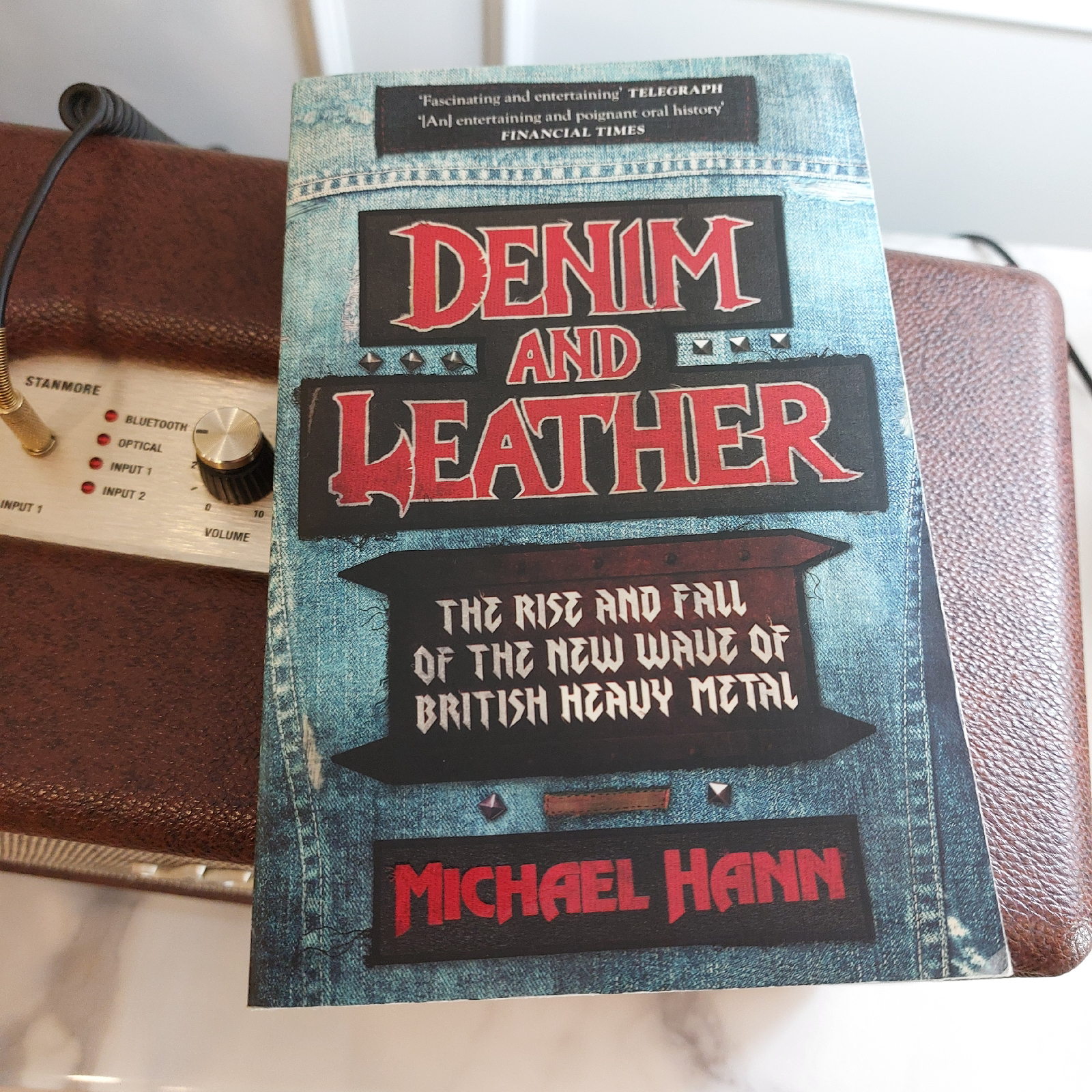
Denim & Leather by Michael Hann

In 1978,  Heavy rock had a certain look and sound. Open chords rang out. Musicians might wear silk or Spandex. Kimonos were not unknown. But by 1983, things were different, and what we now call Heavy Metal was set. Denim or Biker jackets, leather trousers, studded wristbands, and palm-muted riffs. The music got faster and a group of fans dispersed in unfashionable towns had became a tribe. Michael Hann's Denim and Leather is a history of the years that codified Heavy Metal.

You don't actually need to like the NWOBHM to enjoy the book. Reading it feels like flipping through a photo album of a vanished Britain — not the royal weddings and Margaret Thatcher kind, but the one with prefab estates, burned-out Ford Cortinas, and hand-drawn band logos scratched into school desks. Hann takes us back to the early ’80s, to a world where in the North of England bands like the Tygers of Pan Tang played working men’s clubs with sticky carpets and bingo on Tuesdays. There's an especially evocative description of the Marquee Club, complete with Lemmy on the slot machines.

One of then things I enjoyed was its discussion of the importance of Glam on influencing the NWOBHM. Hann’s interviews reveal just how many musicians were turned on by T. Rex and Queen before they ever heard Sabbath or Priest  (the number of future metalheads who cite one of their first singles being Queen’s Seven Seas of Rhye is notable). NWOBHM didn’t emerge out of nowhere — it evolved, often in secret, from teenage glam fans who found distortion. 

That tribal identity was held together not just by the music, but by a scattered but passionate media ecosystem. Kerrang! wasn’t just a magazine; it was a lifeline. The Friday Rock Show on BBC Radio 1, hosted by Tommy Vance, was a weekly communion. And then there was the Monsters of Rock festival at Donington. The description of the first festival is one of the book's highlights, as fan after fan remembers their awe at the size of the crowd and  realizing their were other people jut like them. These were the glue — the things that took a thousand small-town scenes and turned them into a national (and international) movement. And that international point is important, as by the mid 80s, the most important innovate bands were coming from the US and Europe. The New Wave of British Heavy Metal also became the Last Wave.

What Denim & Leather also captures — gently, without judgment — is the inevitable fade. By the mid-’80s, the moment had passed. The bands that didn’t break through disbanded. The music press moved on. Thrash arrived. Glam came back, only now it was American and glossy. The NWOBHM bands who didn’t adapt were relegated to footnotes and second-hand bins. But Hann treats them with respect — not just because they mattered, but because they still do to the people who were there. And to people who maybe missed it the first time but found it later — in old records, fanzines, or forums where people still debate the best Venom record ("In League with Satan").

Tuesday, March 26, 2019

To Disco With Love

I've gone a bit Disco recently.

In part, this was kind of inevitable. After all a lot of the bands I've written about on this blog had their Disco phase, so why shouldn't I have one too? And the truth is, I've always been more than a bit partial to some Disco. I was 10 years old in 1979, and I reckon that you'll find very few people who were that age in that year with free access to a radio and Top of the Pops whose souls aren't momentarily lifted whenever they hear the intro to Funkytown.

But my recent phase has been influenced by David Hamsley's To Disco With Love, a book that  collects together some of the Disco era's album artwork, grouped into different themes (with the mid 70s dominating, there's a lot of golds, browns and sunburnt finishes), The covers are often pretty much as bad as you would expect, but then again, so what? As a Black Sabbath fan, I'm perfectly comfortable with the idea of great music coming with dreadful covers.

And a lot of it was great. Chic and Giorgio Moroder get a lot of the attention these days, but at the moment I prefer the mid 70s period: less glitter more strings plus a sprinkle of high camp (which, let's face it, gave flavour to most of the great pop from the 70s). Disco's borders with Funk and soul were pretty porous, and the book finds space for Kool & the Gang, Philadelphia International and even Ramsey Lewis.


The older I get, the more I like this stuff. And I like it without irony, this is no guilty pleasure, where the Salsoul Orchestra albums are tucked safely away from view. I think it's because it's all upbeat stuff. I find dark and edgy music overrated these days, I'll take the Beach Boys, Stevie Wonder, AC/DC or ABBA any day.

Friday, February 8, 2019

10 Random Thoughts About the Bohemian Rhapsody Film


1 .This whole "Live Aid saved Queen" schtick doesn't wash. They had four hits the previous year (and played two of them during their set). On Now 4, released after the summer of 1984, they're Side 1 Track 1 (Radio Ga Ga): what more scientific proof do you want?  

2. It's hard to think of a pop star who lost their muse so comprehensively. He wrote all of Queen's big hits during the 70s, and then none during the 80s. How do you go from "Killer Queen" to "Man on the Prowl" in 10 years? Conclusion: don't grow a moustache.

3. I can't believe they didn't do the "Ah Mr Ferocious" scene with Sid Vicious.

4. I enjoyed the scenes of them recording A Night at the Opera in the countryside. Somebody should write a book about all the albums that were recorded at various farmsteads during the 70s.

5. Gwilym Lee really was Brian May. I don't think I've ever seen a better resemblance between an actor and a character in a biopic.

6. But Ben Hardy really wasn't Roger Taylor. Roger was a good looking guy, but in the film he looks like a squad member of the 1974 West Germany World Cup team.

7.  I have a slight suspicion that one of the motivations of the band for making this film was to get back at Paul Prenter.

8. The film has John Deacon as being about halfway between Derek Smalls and Balderick and I think this is a bit unlikely. I can't imagine he took too much nonsense from the others after "Another One Bites the Dust".

9. There's a scene where Brian May is taking the band through We Will Rock you and Freddie walks in. With a moustache. In 1977! This is madness. If you're going to be paying so much attention to detail that you make sure that he wears the right brand of trainers, you shouldn't be making these errors. 1977!

10. It's a pretty good film, and I speak as someone whose heart sank like a stone when I heard that they were making it.

Monday, May 22, 2017

Village People and Bjorn Again


When the web site stated something along the lines of “Bjorn Again will support Village People, but both acts will play for the same amount of time”, you suspected that either there had been some tense running order discussions or perhaps the promoters had realised that nobody with a credit card wanted to watch a full set of Village People, even on their 40th anniversary.

I’d seen Bjorn Again previously, so knew what to expect: kimonos, peroxide and a lot of cheese: cheesy Swedish accents, cheesy dance moves and cheesy “this half of the hall sing with me” type banter. Ah, who cares, what you also get are tour-perfected selections from one of pop’s best greatest hits catalogues. The Aussies have been doing this for a while now and obviously know at 8pm on a Friday night their audience is going to consist of people who have put their work week beyond them and have already had a couple of Tiger beers. So their slightly truncated set list found room for stompers such as Ring Ring and Honey Honey, but not the reflective Winner Takes it All. During the set it struck me that there a few better catalogues than Abba’s at removing arses from seats. They went down a storm.

Village People never had a chance. But they could have at least tried. In case you’re wondering, three of them were the original line-up (the Native American, the Soldier, and the Cop – and judging by the shape of the last, the San Francisco Police Department needs to revise it’s annual medical screening). During the second song I found myself saying to Mrs Hawkfall “They’re miming. Only the lead singer has his microphone turned on”. These sentiments were also expressed more loudly to the band by a couple of members of the audience a few songs later. This soured things a little bit, though towards the end of the set they managed to get some of the goodwill back (it was noticeable that the younger, non-original members were able to charm the crowd much more effectively than their elders).

Wednesday, April 19, 2017

The Halo Effect

 The Halo Effect: “If we see a person first in a good light, it is difficult subsequently to darken that light”

In David Hepworth’s book on 1971, he uses the Halo Effect to explain why “What’s Going On” has such a reputation for being a great album (basically, the excellence of the opening and closing tracks casts a halo over the rest of the album).

That got me thinking about where else this effect can be seen. Oddly enough, the first name that came to mind was David Letterman. When he retired a couple of years back, tributes poured in about his 30 years as a talk show host. Yet most of the clips that were recalled were from the 1980s. As someone who only saw his show from the late 90s onwards it was difficult to see what the fuss was about: a fairly cranky middle-aged guy making jokes with his bandleader? I think a lot of the goodwill that was extended to him was a result of the Halo Effect created by his early 80s shows, when he really was a breath of fresh air.

In sports, few teams benefit from the Halo Effect as much as the Brazilian national team. Even though they abandoned their old style of play in the late 80s, we still think of each Brazil team as being the heirs of Jairzinho, Pele, Carlos Alberto and the others of the great 1970 team. Each time a World Cup comes around, there’s talk of “jogo bonito” and “samba style football” that doesn’t bear much resemblance as to what’s happening on the pitch. Similarly, the Dutch team have been counter-attacking bruisers for over a decade, but we still carry a torch for them, because of the Halo Effect cast by Cruyff, Neeskens et al.

Perhaps it’s unfair to talk of the Halo Effect with musicians. There’s a general acceptance that they produce their best work in their 20s, so why give someone a hard time if they’re still around 30 or 40 years later and not producing great stuff? Having said that, there are a couple of names that come to mind. Neil Young is one who seems to retain a lot of goodwill from people who got to know him in the 70s (or 90s), even as he tests their patience with each record. And Morrissey’s career seems to be sustained by the residual energy of the intense relationship with his fans in the 80s.

Monday, January 23, 2017

The Singles Of 1987

1987 is now 30 years ago. I was 18 in 1987, so should love it, but I don’t usually consider myself a big fan. Too much Hair Metal, Stock Aitken & Waterman, Stadium Rock and Karel Fialka. However, I may have to change my opinion a bit because if you look at the singles released in this year, it may have a claim to be great.

Rent
I’ve always preferred Minor Key PSB (Being Boring, Left to my Devices) over hi-NRG PSB (most of the other ones), and I think Rent is their best song. I recall that when Melody Maker did their end of the year review, Andrew Eldritch listed it as his Single of the Year by virtue of the fact that it was the only single he bought that year. “Really. With your money” sniffed the MM.

Rebel Without a Pause
It’s on It Takes a Nation of Millions, but it was recorded and released between their first two albums in 1987. This might well be the group at their peak, and it was easily the most exciting thing I heard that year, far more so than any of the rock or indie records released. What a bloody racket! The genius of Public Enemy was the combination of Chuck D and Flavor Flav, and it’s at its best here. E.F.F.E.C.T otherwise known as effect, you understand what I’m saying?  

Paid in Full
Big year for Hip Hop, 1987. The album version is good, but to be honest it’s the Coldcut remix that really takes this song to the next level, particularly the Ofra Haza sample. Great rhymes too: “a pen and a paper, a stereo, a taper”.

Fairytale of New York
It’s getting overexposed now, and a Xmas when I don’t hear it counts as a success, but it’s still a great song. Didn’t make the no. 1 spot of course; when I saw them at the Edinburgh Playhouse in 1988, Shane McGowan introduced the song as “Here’s one you liked almost as much as the Pet Shop Boys…”

Pump Up the Volume
I actually think that 1987 was another 1965. We’re living in an era defined by dance music and hip hop and 1987 was the year that both really broke through. I’d never heard anything like this before when it hit the charts. Ofra Haza there again.

Fight For Your Right
The album came out in late 1986, so it’s cheating a little bit, but believe it or not it was the 3rd single from the album and didn’t come out till 87. Like most of the first record, it has more to do with Rick Rubin than Ad Rock & co, but who cares? It’s great fun. May have been responsible for Limp Bizkit.

It’s So Easy
The bigger hits would come out the next year, but it all started here, and unlike a lot of other stuff from the album, this one still sounds fresh, probably because it’s so sweary that it never gets played anywhere where sweariness may cause offence.

I’m sure I’m missed stuff. I was hoping to include The Mercy Seat, but that was 1988 apparently, so I may have to reassess that wretched year too. What do you think? Dog of a Year? Or a year of innovation?

Tuesday, December 20, 2016

Hip Hop Family Tree

Ed Piskor’s “Hip Hop Family Tree” makes innovative use of the comics medium to tell the story of Hip Hop. It’s basically a documentary, but instead of aged talking heads reminiscing over old footage, Piskor narrates the story, with the images showing the main characters and action. This technique takes you back and effectively immerses you into the sights and fashions of the periods covered.

The story starts in the Bronx in the 70s and for a while doesn’t travel very far outside; it’s remarkable how much of the early innovation in Hip Hop happened in such a small, concentrated area. Despite this, the number of characters quickly multiplies, and Piskor has his work cut out managing all the competing crews, DJs, club owners and MCs.  Piskor has cited Chris Claremont’s 70s/80s work on the Uncanny X-Men as inspiration for handling an extensive list of characters and it’s there to see in techniques such as introducing characters well before they take centre stage (graphic design student Carlton Ridenhouer is seen listening to early Hip Hop at college, and in a nice touch we see young comics fan Darryl McDaniels reading a copy of the X Men).

Going so far back in time enables Piskor to explain the cultural roots of the genre. The battles between the sound systems at the block parties and the roots in gang culture explain the seam of adversarial braggadocio that still runs through the music. 

The comics are well-researched (with endnotes pointing you to further reading and YouTube clips), but the tone isn’t dry, and though the genre is given the respect it merits, there’s a spiky playful tone throughout. This is evident in how Piskor portrays some of the characters: Rick Rubin is shown as a spoilt, slumming rich kid, while Russell Simmon’s lisp (or as the comic would put it “Ruthell Thimmon’th lithp”) is turned up to 11.

If you’re a Hip Hop fan, you’ll find more than enough detail and verisimilitude here to wallow in. If like me, you’re largely a sympathetic observer, you can enjoy the storytelling chops and artwork, plus find a few things to explore beyond those Public Enemy, Wu Tang Clan and Common albums.

Thursday, July 14, 2016

The Broons in 2016

About twenty years ago someone wrote to the letters page of The Guardian with a set of three questions that could be used to determine whether someone was really Scottish or not. I forget the other two, but one of them was “Who lives at 10 Glebe Street?”. The answer, as anyone who has grown up in Scotland over the last 80 years or so will know is: The Broons. I received a copy of the latest book as a Christmas present (it must be a classic gift for exiled Scots) and it was the first one I’d seen for quite a few years.

If you’re unfamiliar with the Broons, it is a long-running comic strip published weekly in the Scottish Sunday Post newspaper with a book collecting the strips being published every two years or so (And it really is long-running, first appearing in 1936, it’s characters are older than Batman and Superman). The original writer/artist died in the late 60s and since then a series or writers and artists have continued the strip in exactly the same style (there have been no Frank Miller-type Dark Knight re-imaginings of the Broons, though it’s an intriguing thought).

There are four standard Broons storylines:

1. “The Bairn overhears something”. Simple but versatile, the bairn overhears someone talking about one of the family, gets the wrong end of the stick, mobilises panic-stricken family members until it all sorts itself out. Memorably used in Viz’s McBroons strip. Key phrase: “Ha ha! My wee lamb!”

2. “Pa is mean”: Pa Broon tries to save money in a ridiculous way while lecturing the rest of the family on their spendthrift ways. He always comes a cropper and ends up spending more to get less. Key phrase: “Auld Skinflint”

3. “The But and Ben”: All 9 Broons decamp for a holiday in a two-room house in the Scottish countryside. Key phrase: “Look at that teuchter!

4. “The Broons vs Modern Life”: A member of the family will enthuse about a new trend or technology, such as electric shavers or computer games, only for the Broons to put their own stamp on it. In this year’s book, Grandpa Broon comes up with a mince & tatties smoothie, the idea of which is making me feel a bit queasy as I type. Key phrase: “Now that’s what I call a –insert technology name-!”


Why is The Broons still going? It was old-fashioned even when I first read it in the 70s; it can look ridiculously so today. In one of the strips in this year’s book we see Pa Broon at work in what seems to be a shipyard while his son buys a second hand zoot suit for a date. It’s not even that well-written: the bairn these days talks like Jar Jar Binks’s Scottish cousin: “Me disnae think Paw kens how”.

I think one reason it still exists is that it benefits from the powerful Celtic Nostalgia that Scots tend to be subject to (think of Billy Connolly’s line about Scots singing about being far away from Scotland while they’re still there). But I also think it’s linked to the fact that The Broons are one of the first things that a Scot will read by themselves; there are generations who remember having Broons and Oor Wullie books in their childhood libraries. The Broons is a reminder of childhood independence. And because it’s so strongly linked to our childhoods we’re happy to ignore the fact that Pa Broon dresses like something from Peaky Blinders.

Monday, May 30, 2016

Scents of the Seventies


Taking a wrong turn in Singapore’s sprawling Mustafa Centre a few months back, I ended up in 1978. There, facing me from the shelves was a line-up of fragrances that I hadn’t seen in the same place for years: Denim, Old Spice, Tabac and Brut: the fab four of Seventies fragrances. Sure, the livery had changed on a few of them (though I don’t think the Tabac Brand Artwork team has been that busy in the last 40 years) but they were still easily recognizable. Cheap, too. So what does an Afterworder do when he finds himself in a shop with cheap stuff that other folk haven’t been interested in since the 70s? He buys them of course, and here are my reviews.

Denim: For me, the most disappointing of the four: very, very light scent, as if a bottle of Smirnoff had been left open in a flower shop for a couple of hours. This used to be for the man who didn’t have to try too hard. What happened?

Old Spice: Probably the brand that’s had the highest profile over the last 40 years and it had a bit of swagger (it was actually on another shelf by itself and I had to move the can there for the photograph). Reminded you of a well-preserved/botoxed lead singer being reunited with his former band mates. I liked it, but I didn’t hear Carmina Burana.

Brut: Like Denim, it’s changed a bit, with a lighter scent than Henry Cooper would remember. Perhaps it was trying to evoke the ocean, or perhaps it was just cost saving. Better than the Denim, though.

Tabac: Now this was an experience, a fragrance that seems to be entirely composed of long lasting base notes. You could put it on on Monday, and still be all Tabaccy on Friday, even if you have a shower on, say, Wednesday. Perhaps the most Proustian of the four, a couple of dabs of it and the world went a bit Kodachrome. Also, you can’t see it in the picture, but the bottle was exactly the same as the one that sat cold and shivering for years next to the Matey bottle in our bathroom. You can’t buy these memories with 180g reissued vinyl.

Monday, January 11, 2016

1986

 So how was 1986 for you then?

Given that 2016 brings us as far away from that year as Heartbreak Hotel and the Suez crisis were, perhaps it’s time for reflection. It didn’t feel to me like a vintage year for the music at the time, and time hasn’t changed that opinion much, so why is that?

It seems like a year of transition, the decade’s summer holidays. The early 80s pop boom was winding down: Duran Duran, Frankie, Spandau and Culture Club had all seen their best days, but hip hop, house music and hair metal had yet to really make their breakthrough (although they were knocking at the door: Livin’ on a Prayer and Walk this Way both were hits this year).

It also seems to have been a year that a lot of acts that were in their prime at the time sat out. The list of bands who made albums in 1985 and 87 but not 86 is striking: U2, Simply Red, The Cure, The Sisters of Mercy, The Cult, all were touring/resting/drying out. The charts abhor a vacuum of course, and you wonder if bands like The Mission would have been as successful in 1986 had some of the acts on that list made records. Still, this was the year of Parade and The Queen is Dead.

Perhaps the year did have some influence though. For one, this seems to have been the year that bands realised, thanks to live Aid, that they could play stadia instead or arenas. Wham! played Wembley and Queen played Wembley Stadium and Knebworth, where two years previously they had played Wembley Arena and the NEC. Touring would change for good.

Then there was C86. While it can be difficult to name many of the bands that were on the cassette, it does seem to have laid down the basic template for Indie bands that is still used today. Before C86, Indie could have meant Throbbing Gristle or Orange Juice. After, it meant a four piece of floppy-haired students trying to sound like The Smiths. It still does, really.

Elsewhere, while we were able to watch the world’s greatest footballer win the World Cup, we were unaware that a big dreadlocked guy was becoming the first truly modern footballer over at PSV. There was a lot less football on the TV those days.

Wednesday, April 1, 2015

Wedding Songs


What music did you play at your wedding?

As someone who has recently left behind his bachelor days, I'm curious. When my wife-to-be and I were shortlisting the songs we wanted to be played at the march-ins, it had seemed to be a pretty simple task. We knew that they would be 70s Soul songs, as that's the genre where our musical tastes overlap the most. Outside of that, she likes Air Supply, while I like Black Sabbath. She says Tomato, I say Rat Salad.

So it should have been pretty easy to find a couple of nice slices of Philadelphia or some Stax tracks, right? But once we started shortlisting, it turned out to be a bit more difficult than we thought, as favourites started tumbling at early hurdles and sent off to the UHU factory. "Didn't I (Blow Your Mind This Time)?" by the Delfonics was an early frontrunner. We both love the song, and that beautiful introduction sets the stage for a soppy old love song, right? Wrong; he's leaving her, and the title is his kiss-off (and it's a surprisingly mean-spirited one at that. This is a Thom Bell song, remember).

Next up were Earth, Wind & Fire. "Reasons" doesn't quite have the romantic lyrics you might expect from its lovely arrangement, while for "After the Love Has Gone" we didn't even need to look at the lyrics.

Luckily, in the end we had Stevie Wonder and The Stylistics to step up and deliver the goods. "You are the Sunshine of My Life" may not be the most original choice, but I'm damned if I care: it's a beautiful song and performance, and I think that the fact that it's written by a blind man provides the lyrics with a melancholic coating that strengthens the song. And Thom Bell came good in the end with "Betcha By Golly Wow", though to be honest we could have taken just about anything from that first "Best of The Stylistics" album.


Monday, March 23, 2015

Joe's MAC

Shopping for second hand records in places like Singapore (where I live) and Kuala Lumpur is always an interesting experience. As retail rents are high, and vinyl hunting is - despite its current trendiness - still very much a niche interest, you end up in far-flung shopping arcades and warehouses that don't tend to be in the Lonely Planet guides. You rarely find a record shop next to a Starbucks if you know what I mean.

Joe's MAC is a great place to shop in. It's a good bit bigger inside than it looks from outside, and it reveals itself gradually as you walk through it, a bit like the Alcazar in Seville, but with more copies of "A Hard Day's Night". Rooms lead into other rooms with crates of records labelled "New Releases".  In fact, it's a bit like wandering through a video game: you keep glancing for vases in the corner to search for gold coins. I liked that it was organised enough for browsing, but disorganised enough to spring a few surprises, such as finding the NWOBHM band Dark Star's debut album in the Motown section.

Anyway, I picked up Millie Jackson's "It Hurts So Good", "Slade in Flame" and "Now That's What I Call Music II". The Slade album is my favourite one of theirs: you can almost smell the mid 70s from it, and I reckon that all Rock drummers should look the way that Don Powell looks on the cover. The NOW album is from 1984, when pop music was on the turn, and it's patchy: there's still some good stuff on it ("Relax", "Michael Caine", "Radio Ga Ga", "What Difference Does it Make?") but they're distributed pretty sparsely across the two records. One interesting point is how late 1983 and early 1984 saw some big names from the 70s (Rolling Stones, David Bowie, Paul McCartney, Hot Chocolate, Slade) still having hits, but with songs that range from forgettable to dreadful ("Undercover of the Night", "Modern Love", "Pipes of Peace", "I Gave You my Heart Didn't I" and Lord help me, "Run Runaway"). It's the Millie Jackson album I'm happiest with though, I'd been looking for a it for a while and was pleasantly surprised to find it there.

Tuesday, March 17, 2015

Middle Age Lament '15

When do you stop buying the latest record from one of your favourite artists? I'm wondering if there's a helpful checklist or flow chart that I can follow to determine when it really is time to call it a day, remember the good times and have an amicable parting of the ways.

The question has been prompted by the news that Alice Cooper is about to release a covers album of songs by his peers from the 60s and 70s. Honestly, I don't like the sound of it. Covers albums tend to be the ignored stepchildren of artists' discographies, so why should this one be any different? To make things worse, it's got "special guests". Uh-oh.

The problem is that Alice and I go back a long way, about 30 years in fact. A long time that, one which has seen 5 Prime Ministers, 8 World Cups, 5 US Presidents and 256 Spurs managers. I've been listening to Alice longer than the guy from Smokie was living next door to him.

I must have over 30 Alice Cooper records. I've definitely got all the studio albums, this despite the fact that he's only made two really good ones since the 1970s: 1983's "Da Da" and 2003's "The Eyes of Alice Cooper". Having said that, there are surprisingly few clunkers in the catalogue: 1987's "Raise Your Fist and Yell" definitely qualifies: a shrill, Heavy Metal album which manages to contain music even worse than both its title and cover, while 2001's "Dragontown" and 2008's "Along Came a Spider" aren't much fun either. On the whole though, he's managed to keep going by constructing a discography using competent mediocrity as the primary raw material. And I've kept buying them.

Believe it or not, the music is worse than the cover.
 
But recently he's been testing my patience, with live album after live album recorded with the same band playing the same songs. I've stopped buying them and I really think I should do the same with the studio albums as well. At heart I realise that this is an internal struggle: do I let my irrational record collector side override my logical, decision-making side? Now, I've broken ties before; I've never felt any compulsion to own a Black Sabbath record that doesn't have Ozzy or Dio on it, and I gave up with Queen after "Made in Heaven". It feels like it's time to say goodbye here too.

What about you? I can't be alone here. How many long time Simple Minds fans found themselves in HMV staring at the cover of "Street Fighting Years" and thinking "Do I really need this?" John Peel stopped playing T. Rex records after realising that if "Hot Love" and "Get it On" had been recorded by other artists he wouldn't have been playing them. Ever changed your Facebook status with an artist?

Tuesday, October 28, 2014

Hair Metal: The Unforgiven


In Sam Dunn's Metal Evolution TV series, the presenter covers every type of Hard Rock and Heavy Metal you can think of, plus a few you can't. He shows enthusiasm for almost all of them: Power Metal, Progressive Metal, Shock Rock, even Grunge. All apart from one. At the start of the episode of Hair Metal he confesses that it's a form of Metal that we was never able to warm to. And he's not alone.

The first I heard of what would come to be Hair Metal was 1981 or so when Tommy Vance played songs from an album called Too Fast For Love by some American band called Motley Crue on his Friday Rock Show. They had been getting mentions for a while in Kerrang! and this must have been one of the first times they were played on the radio in the UK. God almighty, I thought to myself, this'll never catch on.

The thing is, I should have liked Hair Metal. After all, I was a fan of most of the genre's major influences. I loved the 70s Alice Cooper and Kiss records. (still do). I also liked Van Halen and Aerosmith. So, yes, I should have been a fan really. So why did I end up hating the bloody thing?

I think the main reason was the sound. Hair Metal records sounded really terrible with all that compression. Those thudding snares. Those squawking lead guitars. Perhaps the records were mastered to sound effective on FM radio (or on MTV), but there's something cold and shrill about them. And they don't sound any better thirty years on either. I've become quite forgiving about a lot of 80s music these days (I even own a copy of Rio by Duran Duran). But Hair Metal leaves me as cold today as it did back in the day.

Of course, the irony is I became a fan by proxy. So many of my friends became fans of these bands in the mid 80s that it was pretty much impossible not to become familiar with the latest David Lee Roth, Poison and Cinderella releases. I knew them all. And of course if you listen to any genre enough you'll find something you like. so the track below is from the only Hair Metal album I've heard that I think is really any good, Aerosmith's Permanent Vacation. To me, it's a collection of good songs that are strong enough to withstand Bruce Fairbairn's 80s production. the follow-up Pump was pretty good too, though after that I lost interest.